AI & Network Convergence: Next-Gen Cyber Defense is Here
"The digital perimeter is no longer a wall around an office; it is a living, breathing web of data that requires an intelligent nervous system to defend."
The traditional way of securing a business—building a high wall around a central server—is dead. In a world where your smart lightbulbs, remote laptops, and cloud-based databases are all interconnected, a single firewall is no longer enough.
* Unified Defense: Cisco integrates deep networking expertise with AI to create a single, cohesive defense layer. * Ecosystem Protection: Security now covers everything from IoT devices to cloud environments, not just individual computers. * Proactive Defense: AI shifts the focus from cleaning up after a hack to predicting and stopping attacks before they land. * Scalable Security: This convergence is the only way to manage the massive data flows of remote work and global IoT deployments.

How is the modern digital environment fundamentally different from legacy security models?
A quiet office in 2005 had a clear boundary: a thick door, a few desktop computers, and a single internet connection. If you wanted to get in, you had to pass through the front gate.
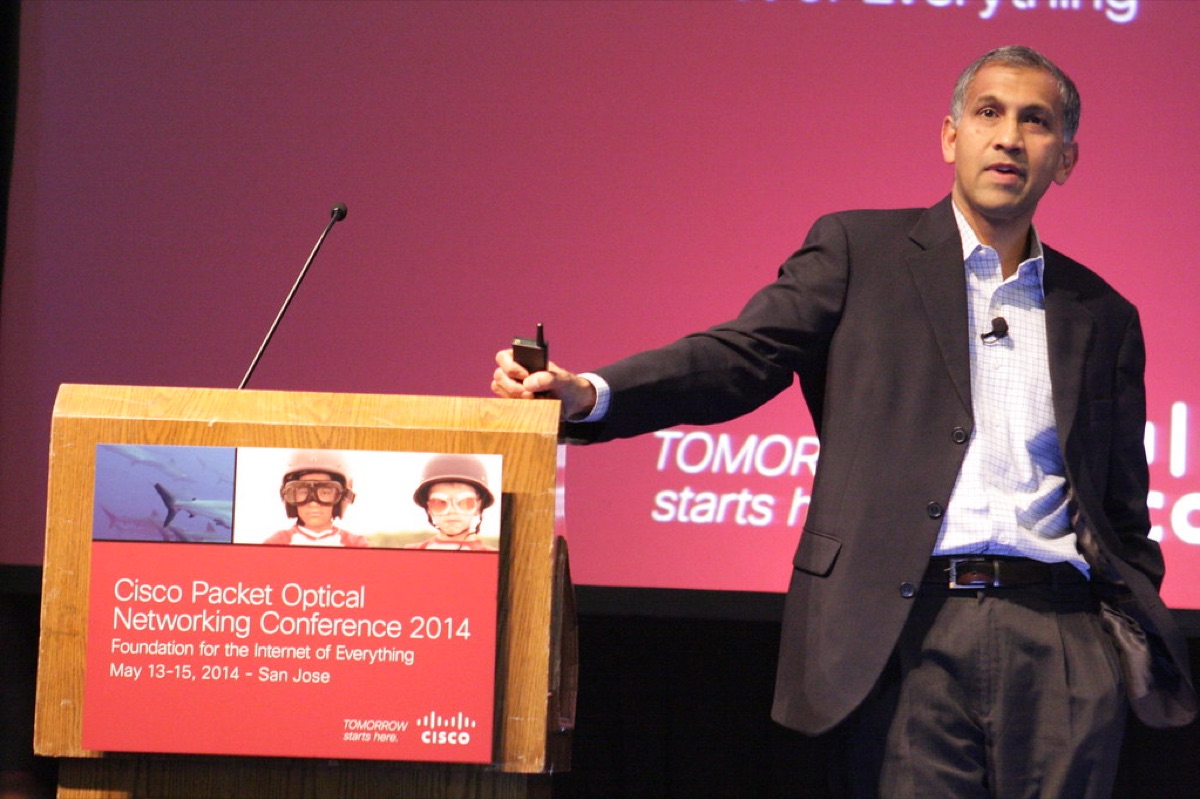
According to Wikipedia: Cisco, the company built a significant presence in India by establishing its Globalization Centre East in Bangalore for $1 billion.
Today, a small business owner might sit in a coffee shop in downtown Seattle, using a laptop connected to a public Wi-Fi, while their warehouse in Austin runs dozens of sensors that talk to a cloud server in Virginia.
The "office" is everywhere, and every single one of those devices is a potential doorway for an intruder. This explosion of interconnected devices—smart sensors, mobile phones, and cloud services—has created a massive, scattered attack surface that traditional security simply wasn't built to handle.
Modern attacks don't wait for a human to notice a suspicious file. They operate at machine speed, moving through networks in milliseconds.
Traditional security tools often act as silos; the antivirus knows about the laptop, and the firewall knows about the internet, but they don't talk to each other. This lack of end-to-end visibility creates blind spots where hackers can hide.
Because the volume of data moving through these networks is now too vast for any human team to monitor, AI has become a necessity to process the sheer scale of information and find the needle in the haystack.
But looking at a screen full of data isn't enough to understand the threat.
What does the convergence of Network Technology and AI actually look like in practice?
Late at night in a silent server room, a blue light flickers across a technician's face as a sudden alert vibrates against their palm.
Imagine a security guard who doesn't just look at ID cards but understands the unique walking gait, heart rate, and subtle habits of every person in a building to know exactly who belongs.
In a technical sense, this convergence happens when deep packet inspection—the ability to look closely at data moving through a network—meets machine learning. Cisco’s deep understanding of network protocols allows AI models to learn what "normal" looks like for a specific environment.
Instead of looking for a specific virus name, the system learns the heartbeat of your network.
This shifts the defense from reactive to proactive. Traditional security relies on "signatures"—essentially a digital wanted poster for known viruses. If a new virus doesn't match a poster, it gets in. AI-driven security looks for behavioral anomalies.
If a printer suddenly starts trying to access the HR database, the AI recognizes this as an impossible behavior and acts immediately.
This is also how Zero Trust works in the real world. Zero Trust is the principle of "never trust, always verify." In a connected world, AI helps enforce this by constantly assessing context.
It doesn't just check your password at 9:00 AM; it continuously monitors your device's health, your location, and your behavior. If your laptop suddenly starts behaving like a botnet, the AI can revoke your access in real-time.
This is especially critical for securing the "edge"—the billions of IoT devices that often lack built-in security. AI can profile these devices, ensuring a smart thermostat doesn't become a bridge into your corporate data.
However, even the smartest system has its limits.
How does this integrated approach protect against modern threats?
A hacker sits in a dark room, watching a screen as a single, tiny error in a corporate network allows them to slip through a digital crack.
Modern threats like ransomware often start with a quiet, low-level intrusion. An attacker might use a sophisticated phishing email to compromise a single user, then spend weeks moving laterally through the network to find the most valuable data.
This is called a "low-and-slow" attack, and it is designed to bypass simple security checks.
An integrated approach allows for threat hunting at scale. While a human analyst might see a thousand separate alerts, an AI-driven system can correlate those alerts.
It can see that a suspicious login in London, a strange data transfer in New York, and a sudden spike in encrypted traffic are actually all part of the same coordinated attack.
This enables automated micro-segmentation. If a device is detected as compromised, the system can automatically "quarantine" it, cutting it off from the rest of the network before the ransomware can spread to other departments.
This ability to see the entire kill chain—from the initial phishing email to the final data theft—is only possible when security is integrated into the very fabric of the network.
But what happens when the threat isn't a hacker, but a mistake?
| Feature | Legacy Security | AI-Driven Integrated Security |
|---|---|---|
| Primary Focus | Perimeter Defense (The Wall) | Ecosystem Defense (The Web) |
| Detection Method | Signature-based (Known threats) | Behavioral-based (Anomalies) |
| Response Speed | Manual/Human-led | Automated/Machine-speed |
| Visibility | Siloed (Device-by-device) | Unified (End-to-end) |
| Core Principle | Trust but verify | Never trust, always verify (Zero Trust) |
Beyond Enterprise: How does this impact small businesses and remote workers?
A freelancer works from a quiet home office, unaware that their unsecured home router is being used as a staging ground for a global cyberattack.
While large corporations have massive budgets, the shift toward AI-integrated networking is just as vital for small businesses and remote workers. For a small business, managing a separate security stack for every employee is expensive and complex.
An integrated approach allows for a "set and forget" level of security where the network itself acts as the protector.
For the remote worker, the home network is now the corporate network. If a home router is compromised, the business data on a laptop is at risk. Integrated security helps bridge this gap by providing enterprise-grade protection that travels with the user, regardless of where they plug in.
When I was looking into this, I realized that most people don't realize their home coffee maker or smart light might be the entry point. It makes you rethink every device in your living room.
- Identify All Assets: Use automated discovery tools to find every device on your network, from laptops to smart plugs.
- Implement Least Privilege: Ensure devices and users only have access to the specific data they need to do their jobs.
- Enable Multi-Factor Authentication (MFA): Always use a second form of verification to prevent hijacked credentials from being useful.
- Automate Updates: Ensure all network hardware and software are set to update automatically to patch vulnerabilities.
- Monitor for Anomalies: Use security tools that alert you to unusual behavior, not just known viruses.
It is important to note that these tools are not a silver bullet. No amount of AI can fully compensate for a user who willingly hands over their credentials to a phishing site or ignores critical security warnings.







Comments 0