Secure Your Data: Enigma's Wisdom for 21st Century Defense
"The machine was believed to be perfect, but human logic found the cracks."
The collapse of historical ciphers reveals the fundamental vulnerabilities in our modern digital security.
* The Enigma machine fell not because its math was wrong, but because its "key space" was limited. * Brute force attacks are primitive, but as computing power grows, even the strongest encryption faces threats. * Modern security relies on moving beyond mere password length toward unpredictability and robust multi-factor authentication.

How did the most secure door in the world suddenly creak open?
In the dim moonlight of the silent hallway, a cold breeze brushed against my skin as the heavy steel latch clicked open.
The air in the Bletchley Park workshop is heavy with the scent of ozone and the rhythmic, metallic clicking of moving gears.
It is late at night in 2026, and I am sitting on my couch, glancing at a security update notification on my smartphone with a strange sense of unease. Eighty years ago, in the early 1940s, a similar tension filled the drafty rooms of Bletchley Park in England.
Researchers sat hunched over desks cluttered with tangled wires and brass rotors, frantically scribbling calculations. They were facing the Enigma, the German military's supposedly unbreakable cipher machine.
The Enigma used a variable system where settings changed every single day. The German high command was certain that the sheer number of possible combinations was so massive that no human or existing calculator could ever crack it. However, within that "perfect randomness," a fatal flaw was hidden.
This historical turning point was about much more than winning a war; it provided the foundational lessons for "key space" and "brute force attacks"—concepts that govern every digital interaction we have today. How did they manage to tear down such an impenetrable fortress?
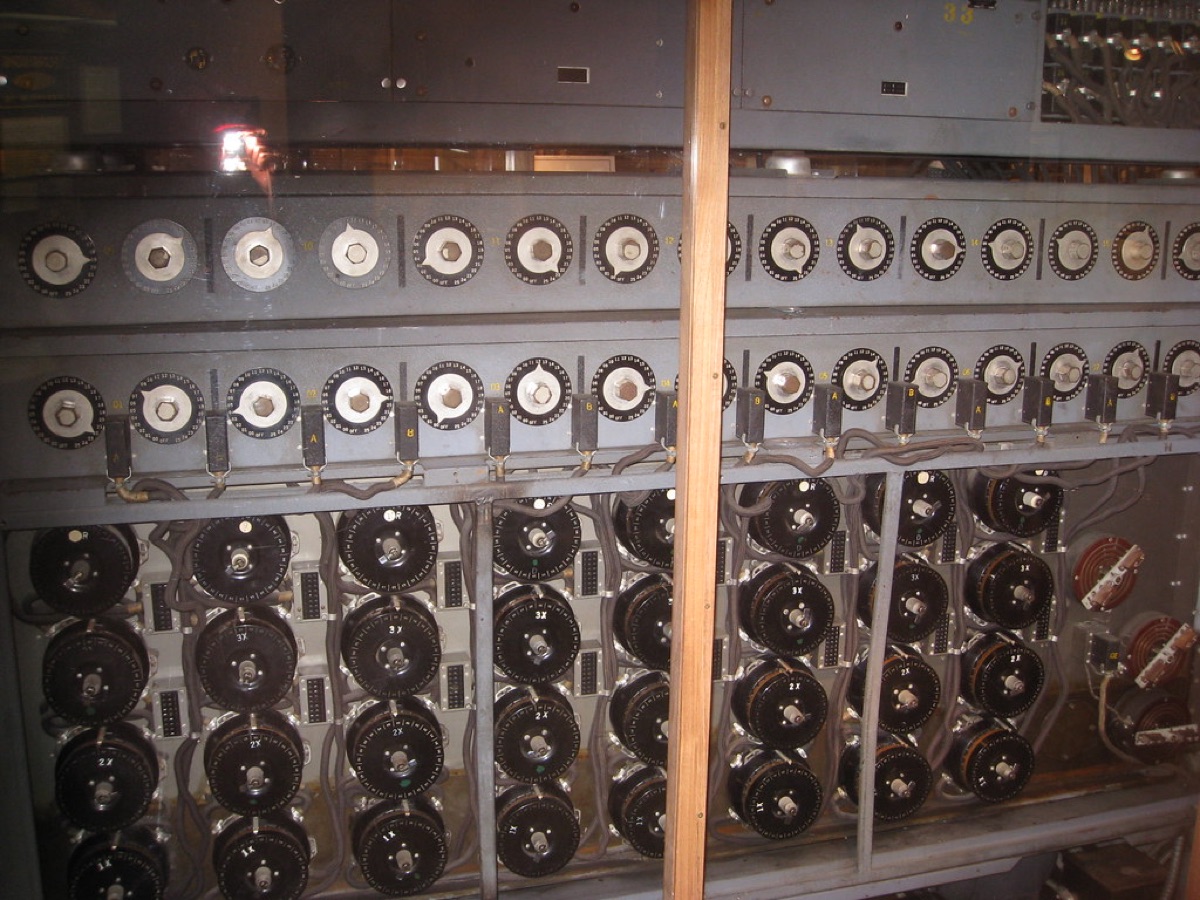
What was the mathematical loophole hidden in the gears? The Enigma worked by using rotating wheels, called rotors, to swap one letter for another in a constantly shifting pattern. Because the ciphertext changed entirely based on the machine's settings, it seemed impossible for an outsider to know which configuration was being used.
However, the codebreakers didn't try to break the math itself; they targeted the "number of possibilities" the math allowed. In cryptography, this is known as the "key space." The key space is the total set of all possible configurations a cipher can take.
While the Enigma's key space was vast, it had a logical loophole: certain words or phrases could never be represented in specific ways. Codebreakers began to narrow the possibilities by reverse-engineering how specific words—like "weather" or "Heil Hitler"—might appear in the ciphertext.
This is almost identical to how modern brute force attacks function.
Is it brute force or computing power that will win? A brute force attack is the most primal method of hacking: simply trying every possible combination until one works. The early machines built to crack Enigma were essentially tools designed to automate ands accelerate this exact process.
The same principle applies to our digital lives today. An eight-character password might seem like it has enough combinations to be safe, but to a high-performance computer capable of billions of calculations per second, it is merely a "narrow key space" that can be cracked in an instant.
The first lesson from the Enigma is that an algorithm that is theoretically perfect becomes useless once computing power exceeds its complexity. What used to take a human lifetime to calculate is now automated by algorithms and hardware.
This is why we cannot just rely on simple character combinations; we must consider computational complexity.
| Category | Enigma Era Security | Modern Digital Security |
|---|---|---|
| Primary Threat | Manual calculation and logical loopholes | High-performance computing and algorithmic flaws |
| Attack Method | Pattern analysis based on specific words | Brute force and dictionary attacks |
| Defense Strategy | Increasing complexity of rotor combinations | Increasing key length and advanced algorithms |
| Core Element | Physical machine settings | Digital keys and authentication tokens |
Security collapses the moment a pattern emerges
The codebreakers found success by identifying the operational habits of the German military. They noticed messages were sent at specific times or that certain characters were never used in specific positions. They turned human predictability into a digital vulnerability.
In modern security, this is the problem of "predictability." If a user chooses a password containing their pet's name, their birthday, or their street address, they are handing the attacker a massive pattern.
Instead of guessing random strings, attackers use "dictionary attacks," testing the most likely patterns first.
The fall of the Enigma proves that security is not just about a complex algorithm. Even the most sophisticated math fails if the way it is used reveals a pattern. Modern security focuses not just on complexity, but on ensuring absolute randomness and unpredictability.

A practical guide to building a stronger shield
What can we learn from this history to protect ourselves today? In 2026, follow these steps to secure your digital life:
- Expand your key space (Password Complexity): Use long passwords (12+ characters) that combine uppercase, lowercase, numbers, and symbols. This exponentially increases the time required for a brute force attack to succeed.
- Eliminate patterns (Ensure Randomness): Never use easily guessable information like anniversaries, birthdays, or common words.
- Implement multi-layered defense (2FA): Even if your password is stolen, you must use Two-Factor Authentication (2FA) or Passkeys. Think of this as a second, independent lock on your digital door.
- Practice regular management: Use different passwords for every service so that a single breach doesn't lead to a total system collapse.
This systematic approach isn't just about convenience; it is the only way to stay ahead of attackers using increasingly powerful hardware.
The limits of security and the threats of the future
Every form of security has a shelf life. Just as the Enigma was once considered invincible until the advent of modern computing, the algorithms we trust today may become useless in the face of quantum computing.
Quantum computers have the potential to increase decryption speeds exponentially. This could effectively shrink our current "key spaces" to almost nothing in an instant.
Because of this, security experts are already developing "Post-Quantum Cryptography" (PQC) to prepare for the next generation of brute force attacks.
We must always ask: "Is my current security enough for the future?" Security is not a finished state; it is a continuous process of responding to evolving threats.








Comments 0